Charleston's $500M Housing Gamble: What the CHA-Integral Deal Means for the Peninsula
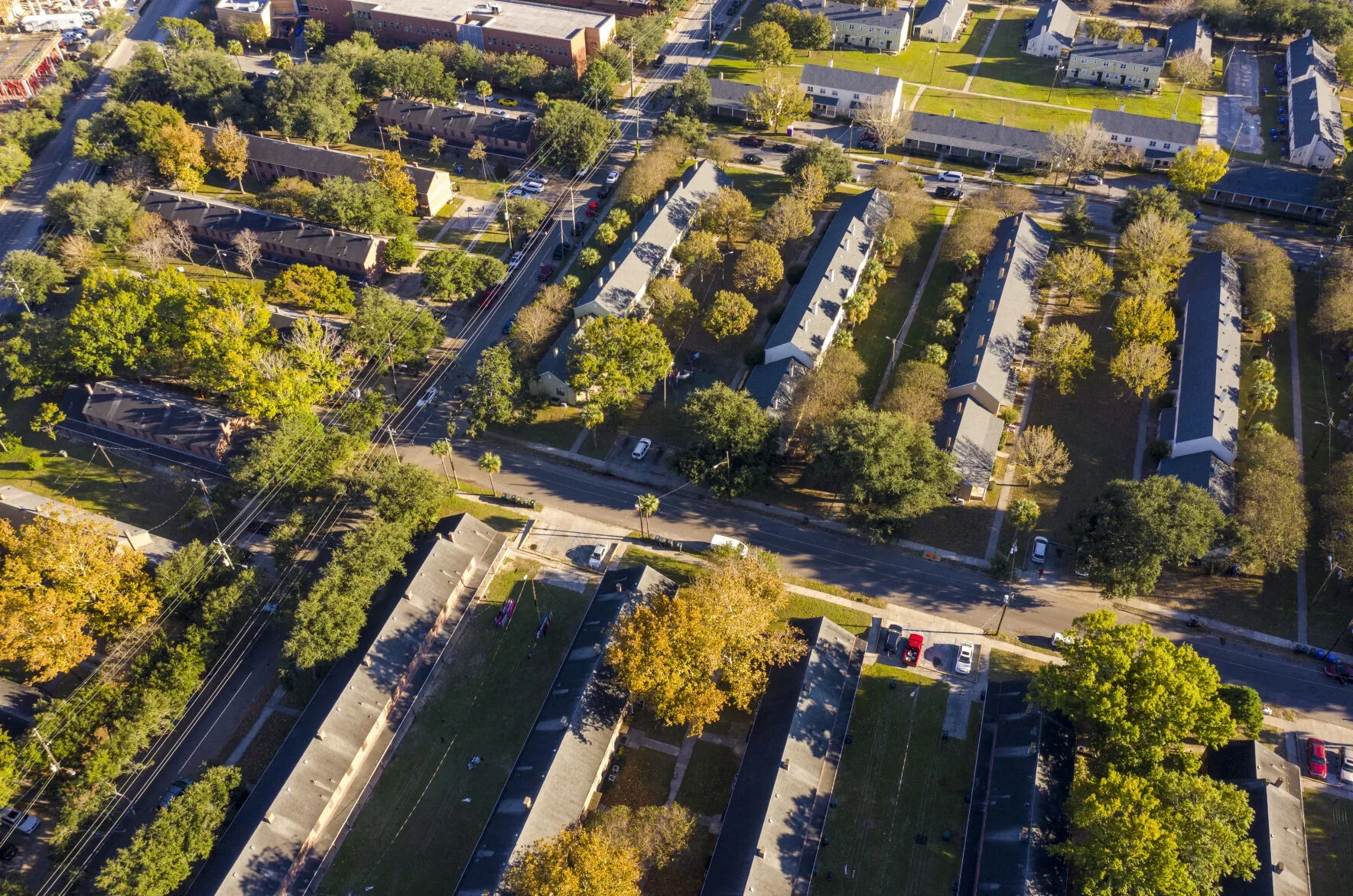
Photo: Post & Courier
On August 18, the Charleston Housing Authority's board voted to amend its existing agreement with Integral, an Atlanta-based urban development firm, to move forward with the redevelopment of two aging public housing sites on Charleston's upper peninsula:
Cooper River Courts — 213 units, built in 1941, located off Meeting Street near the Ravenel Bridge
Meeting Street Manor — 73 units, built in 1952, adjacent to Cooper River Courts
Combined, these two properties sit on roughly 22 acres of peninsula land. The current 286 units will be demolished and replaced with approximately 1,545 mixed-income homes — a mix of affordable, workforce, and market-rate housing.
The developer is Integral, the same firm CHA's board unanimously selected back in April 2024. Ramos Architecture and Design, a Charleston-based firm, has been tapped to begin working on site designs immediately.
The project was originally called Morrison Station. The price tag: north of $500 million.
The Political Backstory
This didn't happen smoothly. Here's the timeline:
April 2024: CHA's board selects Integral to redevelop the properties. The plan calls for over 1,000 mixed-income apartments.
January 2026: Mayor William Cogswell sends a letter to CHA's board chairman asking them to terminate the Integral contract entirely. His argument: "much has changed" since the deal was signed. Cogswell's counter-proposal is Project 3500 — a city-led initiative to "re-imagine all of the public housing downtown" (about 50 acres) and build 3,500 affordable units by 2032. He wants the city, not CHA, driving the bus.
March 2026: The city launches community engagement for Project 3500, including a weeklong design charrette at Dock Street Theatre with architects from Savannah and London.
May 2026: In a joint statement, Cogswell, CHA's new CEO Nathan Simms Jr., and Integral's COO Daryl Jones announce "renewed alignment and momentum." But no new contract is signed. Cogswell proposes a three-party partnership (city + CHA + Integral). CHA doesn't commit.
August 13, 2026: The city issues RFPs for architects to design housing on Project 3500 sites. Notably, this includes land the city doesn't yet control — two-thirds of the 60 acres it put out to bid is still CHA property.
August 18, 2026: CHA's board votes to amend its agreement with Integral and move forward — without adding the city to the contract. The board keeps control. The mayor's ask for a three-party deal is effectively declined.
The subtext is straightforward: CHA doesn't trust that folding into the city's larger vision would actually get units built faster. They have a developer ready to go, an architecture firm lined up, and a contract that's already two years old. They chose execution over negotiation.
What 1,545 Units on the Upper Peninsula Actually Means
This isn't a suburban apartment complex going up on Dorchester Road. This is 1,545 homes on the upper neck of the Charleston peninsula — one of the most land-constrained, infrastructure-stressed, and historically significant areas in the Southeast.
Here's what that means practically:
Density. The current sites house 286 units on ~22 acres. The redevelopment multiplies that by more than 5x. Even accounting for modern site planning (mixed heights, green space, structured parking), this is a fundamental change in neighborhood density.
Traffic and infrastructure. The upper peninsula already deals with Meeting Street congestion, I-26 on/off-ramp bottlenecks, and limited east-west connectivity. Adding 1,500+ households means thousands more daily car trips, school runs, and delivery vehicles on roads that were designed for a fraction of that load.
Schools. Charleston County School District is already navigating enrollment shifts on the peninsula. Sanders-Clyde, James Simons, and Memminger are the closest elementary options. A project of this scale will require planning for hundreds of additional school-age children.
Property values. This is where it gets interesting for homeowners in the surrounding blocks. Mixed-income redevelopment of deteriorating public housing generally increases neighboring property values — the research on HOPE VI projects nationally supports that. But the construction period (likely 5-7 years with phasing) brings noise, dust, traffic disruption, and uncertainty. Short-term pain, probable long-term gain.
Retail and commercial. A neighborhood of 1,500+ units needs services: grocery, pharmacy, daycare, restaurants. Expect commercial components to be part of the plan, similar to what's happening at Magnolia Landing and Ashley Landing elsewhere in the city.
Who Benefits and Who's at Risk
Current residents. This is the hardest part. CHA has committed to a "right to return" for existing residents — meaning families currently living in Cooper River Courts and Meeting Street Manor should be able to move back into the new development at the same rent level. But displacement during construction is real. Temporary relocation, even with vouchers, disrupts lives, schools, routines, and community ties. The track record on right-to-return nationally is mixed. Some cities have done it well. Others have watched residents scatter and never come back.
The mixed-income model. The development will include units at multiple income tiers: deeply affordable (for current public housing residents), workforce housing (for teachers, nurses, service workers), and market-rate units (to cross-subsidize the affordable ones). This model works when executed honestly. It fails when affordable units get designed as afterthoughts with separate entrances and inferior finishes. The architecture and site design phase will determine which version Charleston gets.
Peninsula homeowners. If you own property on the upper peninsula — Eastside, Wagener Terrace, North Central — this project will affect your neighborhood character and likely your property value. Historically, replacing concentrated poverty with mixed-income development has been a net positive for surrounding values. But the transition period is unpredictable.
The city. Cogswell's Project 3500 is still happening on other sites. But the CHA vote means the two largest parcels of publicly-owned peninsula land (Cooper River Courts and Meeting Street Manor) are now moving under CHA's direction, not the city's. The mayor still has influence — zoning, permitting, infrastructure — but he doesn't have the contract.
Timeline and What to Watch Next
Based on the current trajectory:
Now through early 2027: Ramos Architecture develops site designs. Community engagement sessions (expect these by late fall 2026). Environmental reviews and permitting.
2027-2028: Final approvals, financing assembly (likely a mix of Low-Income Housing Tax Credits, HUD funding, private equity, and possibly New Markets Tax Credits). Demolition of existing structures could begin as early as late 2027.
2028-2032: Phased construction. Projects of this scale typically build in 3-4 phases over 5-7 years. Don't expect all 1,545 units at once. Expect 300-400 unit phases with the first residents moving in around 2029-2030.
Key things to watch:
The design. Will it look like Charleston, or will it look like an anywhere-USA apartment complex? The architecture firm is local, which helps. But financing pressures often push toward cost-engineering that strips character.
The unit mix. What percentage affordable vs. market-rate? The details haven't been published yet. This is where the real negotiation happens.
Infrastructure commitments. Who pays for road improvements, stormwater, school capacity? The city will need to invest regardless of whether they control the contract.
Right-to-return execution. How CHA handles temporary relocation for 286 households will determine whether this project earns community trust or destroys it.
What happens to Project 3500. The mayor's initiative is broader than these two sites. But losing the two biggest parcels to CHA's independent process means Project 3500 needs other land — and the city's Aug 13 RFP suggests they're already pivoting.
FAQs
What is the CHA-Integral deal?
The Charleston Housing Authority voted on August 18, 2026, to move forward with Atlanta-based developer Integral to demolish and redevelop Cooper River Courts and Meeting Street Manor into 1,545 mixed-income homes. The project has been in discussion since 2024 and is estimated at over $500 million.
What is Project 3500?
Project 3500 is Mayor William Cogswell's initiative to build 3,500 affordable housing units in Charleston by 2032. It targets city-owned land and publicly-owned sites on the peninsula. The CHA redevelopment is considered part of this broader goal, though CHA is proceeding independently of city control.
Will current residents be displaced?
Temporarily, yes. CHA has committed to right-to-return policies, meaning current residents should be able to return to the new development at their current rent levels after construction. However, construction phasing means residents will need to relocate during the build period.
How long will construction take?
Based on comparable projects and the scale involved, expect 5-7 years of phased construction once demolition begins. First units could be available by 2029-2030, with full completion around 2032-2033.
How will this affect property values on the upper peninsula?
Research on similar mixed-income redevelopments nationally (HOPE VI program) shows that replacing concentrated public housing with mixed-income development generally increases surrounding property values over time. Short-term disruption during construction is likely.
Why did the mayor want CHA to cancel the contract?
Mayor Cogswell proposed that the city take the lead on redeveloping all peninsula public housing (~50 acres) under one unified vision. He argued the city could move faster, attract better design, and coordinate infrastructure more effectively. CHA's board disagreed and chose to keep their existing developer relationship.
Who is Integral?
Integral is an Atlanta-based urban development firm specializing in mixed-income housing. They've completed similar transformations in Atlanta, including the redevelopment of former public housing sites into mixed-income communities. They were selected by CHA's board in April 2024 through a competitive process.
The Bottom Line
Charleston's upper peninsula is about to change more in the next decade than it has in the last 50 years. The CHA-Integral deal is the single largest piece of that transformation: 1,545 homes where 286 currently stand, a half-billion-dollar bet on mixed-income density in one of the most land-constrained urban cores in the Southeast.
Have questions about how development on the peninsula affects your property? We live here, invest here, and build here. Happy to talk through what this means for your specific situation.
📞 843-983-6610
Charleston Revival Homes is a locally owned real estate investment company founded by Sean McMullen and Matt Gaylord. Based in Charleston, SC, buying and building since 2018.